
Fuel Pump Failure Diagnostic Tool
Select all symptoms your car is experiencing:
-
(Common sign of pump failure)
-
(Especially on hills or highway)
-
(Especially at 60+ mph)
-
(Especially when tank is low)
-
(Consistent drop over 3+ tanks)
-
(No P0190 or P0087 codes)
Important: This tool analyzes symptoms from the article but is not a professional diagnostic tool. Fuel pump failures can be dangerous. Always have your vehicle inspected by a qualified mechanic for confirmation.
Probability
0%
Recommendation: No significant symptoms detected. Check other components like spark plugs or air filter.
If your car sputters on the highway, struggles to start after sitting overnight, or dies suddenly without warning, it might not be your battery - it could be your fuel pump. Many drivers mistake these signs for a bad spark plug or clogged filter. But if you’ve ruled out the easy fixes, the fuel pump is often the real culprit. Unlike other parts that wear slowly, fuel pumps can fail suddenly, leaving you stranded. Knowing the early signs can save you from a costly tow and a dangerous situation.
It Won’t Start - Even When the Battery Is Fine
You turn the key, and the engine cranks like normal. No clicking. No warning lights. But it just won’t catch. That’s one of the most common signs of a failing fuel pump. If the pump can’t deliver enough fuel to the engine, it won’t ignite - no matter how good your spark plugs are. This isn’t a slow fade. It’s often a sudden stop. I’ve seen cars that started fine in the morning, then refused to turn over after lunch. No codes. No check engine light. Just silence where there should be a roar.
Try this quick test: turn the key to "on" (don’t start it) and listen near the back seat or fuel tank. You should hear a quiet hum for two to three seconds. That’s the pump priming the system. If you hear nothing, the pump isn’t getting power - or it’s already dead. A bad relay or fuse can cause this too, but if those are fine, the pump is your next suspect.
Loss of Power Under Load
Ever been on the motorway, trying to overtake, and your car suddenly loses steam? It’s like the engine forgets how to breathe. That’s not just bad gas. That’s the fuel pump struggling to keep up. When you accelerate hard, the engine demands more fuel. A weak pump can’t deliver the volume needed. You’ll feel hesitation, a lag before the car responds, or even a sudden drop in speed.
This often happens when the car is hot. After driving for 30 minutes or more, the pump overheats and shuts down temporarily. Once it cools off, it works again - which makes drivers think it’s "intermittent". But that’s exactly how failing pumps behave. They work fine when cool, then collapse under stress. If this happens regularly, especially on hills or during highway driving, don’t ignore it.
Engine Stalling at High Speeds
Stalling at 60 mph? That’s not normal. A healthy fuel pump keeps fuel flowing smoothly under all conditions. If the pump is failing, it might manage low speeds just fine, but at higher RPMs, it can’t keep up. You’ll feel the engine sputter, then die. Sometimes it restarts right away. Other times, you have to coast to the shoulder and wait 10 minutes.
This is especially dangerous on busy roads. Unlike a misfire, which might just make the car run rough, a fuel pump failure cuts fuel completely. No warning. No warning light. Just silence. I’ve seen three cars in Bristol alone this year that died on the M32 because of this. All had over 80,000 miles. Age and heat are the killers.
Whining or Loud Noises from the Fuel Tank
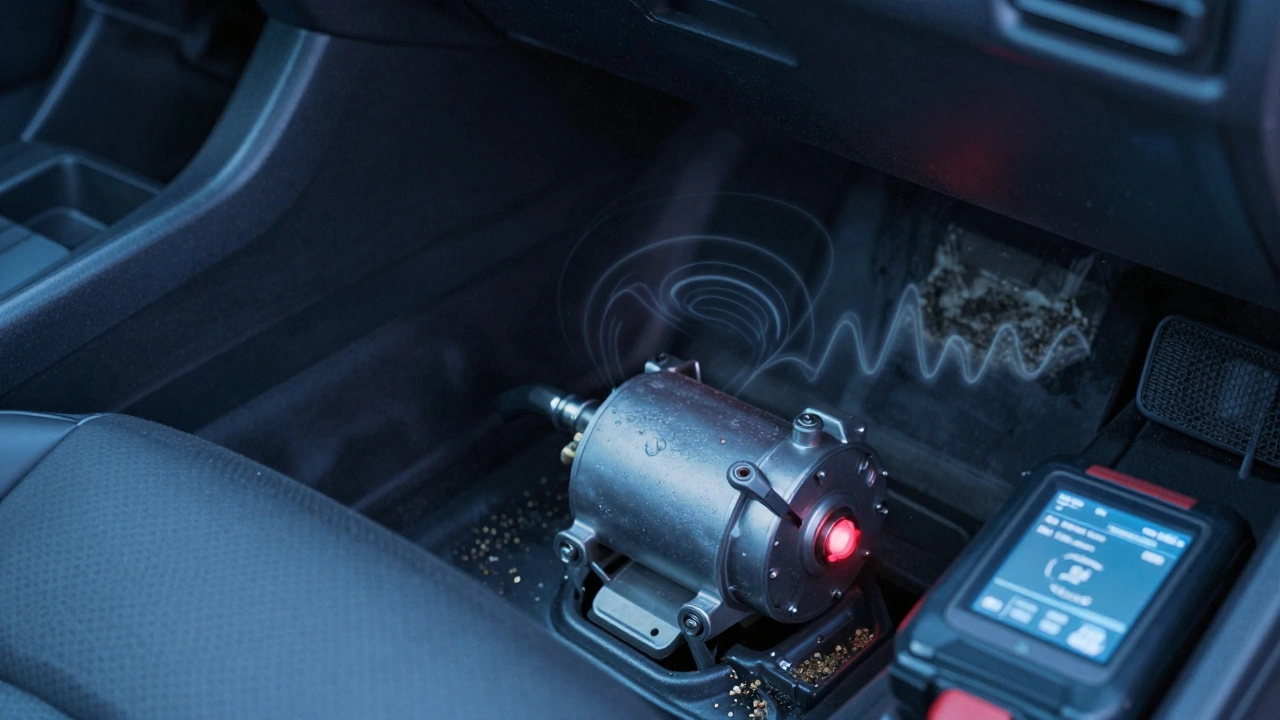
Every fuel pump makes a quiet hum. That’s normal. But if you hear a high-pitched whine, a grinding sound, or a loud buzzing coming from the back of the car - especially when the engine is running - that’s trouble. It means the pump’s internal components are wearing out. The motor is straining. The impeller might be damaged. Or there’s debris in the tank grinding against the housing.
Some people think it’s just the fuel level sensor. But if the noise gets louder as the tank empties, that’s a clue. Fuel acts as a coolant and lubricant for the pump. When the tank is low, the pump runs hotter and noisier. If you’re constantly driving with less than a quarter tank, you’re accelerating wear. A new pump might fix it, but cleaning the tank and replacing the filter is just as important.
Reduced Fuel Efficiency
If your car used to get 38 mpg and now it’s down to 28, and you haven’t changed your driving habits, it’s not the tyres. A failing fuel pump can cause this too. If it’s leaking internally or not regulating pressure correctly, it might be flooding the engine with too much fuel. That’s wasteful. Or, if it’s delivering too little, the engine’s computer might compensate by enriching the mixture - again, burning more fuel than needed.
Check your fuel economy over 3 full tanks. If there’s a consistent drop, and you’ve ruled out a dirty air filter or bad oxygen sensor, the fuel pump is worth testing. Modern cars are precise. Even small drops in fuel pressure throw off the whole system.
Check Engine Light? Maybe - But Not Always
Don’t wait for the check engine light. Many failing fuel pumps don’t trigger codes. The car’s computer monitors fuel pressure, but if the pump is failing gradually, it might stay within the acceptable range - just barely. So you get no warning. That’s why symptoms matter more than lights.
That said, if you do get a code, look for P0190 (Fuel Rail Pressure Too Low) or P0087 (Fuel System Pressure Too Low). These are strong indicators. But if those codes don’t show up, and you’re experiencing the other symptoms, don’t assume it’s fine. The computer isn’t always smart enough to catch a dying pump.
What Happens When It Dies Completely?
It’s not dramatic. There’s no explosion. No smoke. Just silence. The engine stops running. You can’t restart it. You might think it’s the battery. Or the starter. But if you’ve tested those and they’re fine, the fuel pump is the most likely cause. In cold weather, it can fail outright. In heat, it might overheat and shut down, then work again after cooling.
Once it dies, you’re not driving until it’s replaced. There’s no bypass. No workaround. It’s a single point of failure. That’s why catching it early matters.
How to Confirm It’s the Fuel Pump
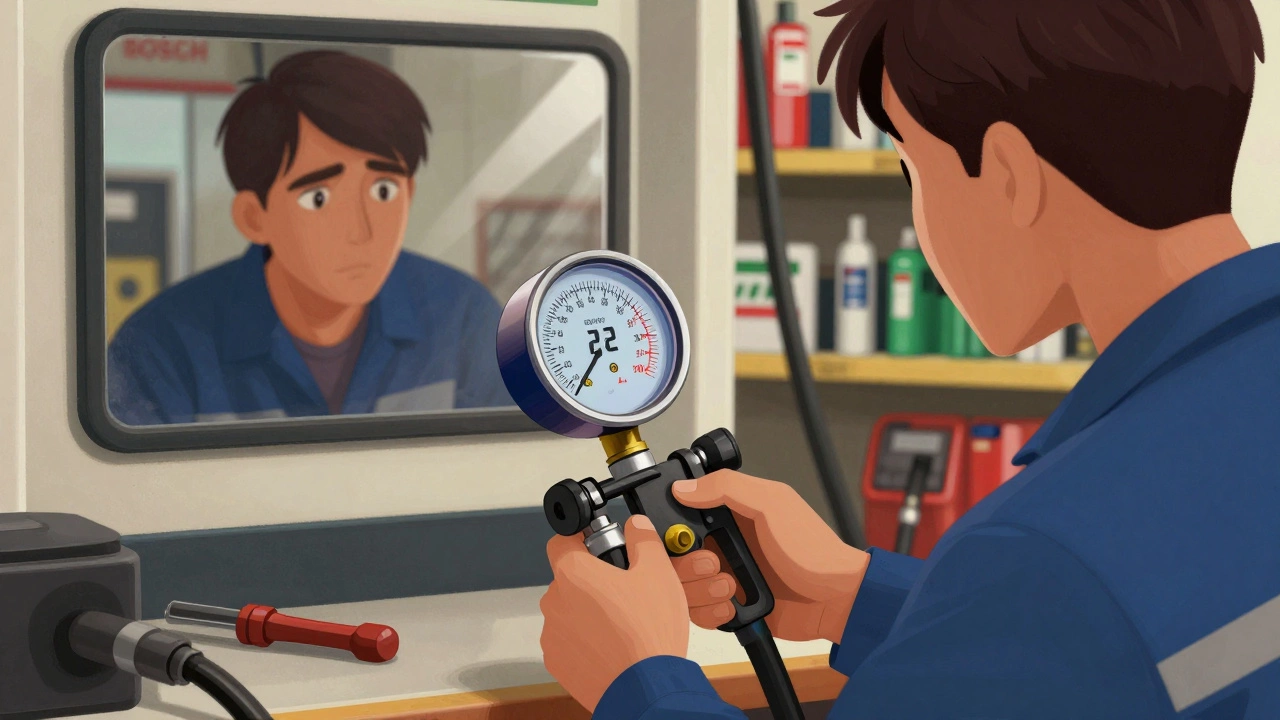
You can test fuel pressure with a gauge. Most garages have one. You hook it up to the fuel rail - usually near the engine - and check the pressure while the engine runs. For most petrol cars in the UK, normal pressure is between 30-60 psi. If it’s below 25 psi, the pump is weak. If it drops under load, it’s failing.
Or try the listening test again: turn the key to "on" and listen. No hum? Check the fuse and relay first. Swap the relay with another one in the fuse box (like the horn relay) to test it. If the pump still doesn’t hum, it’s likely dead.
Another trick: spray a little starting fluid into the air intake. If the engine turns over and runs for a few seconds, that means it’s getting spark - but not fuel. That’s a dead giveaway.
When to Replace It - And What to Do Next
Most fuel pumps last between 100,000 and 150,000 miles. If your car is older than 10 years and you’re seeing multiple symptoms, replacement is the smart move. Don’t wait for it to die on the motorway.
When replacing it, always change the fuel filter too. And if your tank is dirty, clean it. Debris from old fuel or rusted tanks kills new pumps fast. Use a reputable brand - not the cheapest one you can find. A Bosch or Denso pump costs more upfront but lasts twice as long as a no-name part.
Also, keep your tank at least a quarter full. Running on empty overheats the pump and pulls in sediment. It’s cheap insurance.
Common Mistakes to Avoid
- Replacing spark plugs or the air filter and thinking that’ll fix a fuel pump issue - it won’t.
- Assuming the check engine light will tell you everything - it often won’t.
- Buying the cheapest fuel pump online - they fail faster and can damage your engine.
- Ignoring noise from the tank - that’s your early warning.
- Driving with less than a quarter tank regularly - it shortens pump life by 40%.
It’s not complicated. Listen. Observe. Test. If your car’s acting strange and the easy fixes don’t work, the fuel pump is probably the answer.