Spark Plug Savings Calculator
Your Current Situation
Expected Benefits
With new spark plugs, you'll regain:
- 10-15% better fuel economy
- Faster cold starts
- Reduced emissions
- Protection against catalytic converter damage
Think your car runs fine with old spark plugs? You might be one misfire away from a costly repair. Spark plugs don’t last forever-even if your engine still turns over. The truth is simple: new spark plugs are always better than old ones when it comes to performance, efficiency, and reliability.
Why old spark plugs hurt your car
Old spark plugs don’t just wear out-they degrade in ways you can’t always feel. After 30,000 to 100,000 miles (depending on type), the electrodes erode. The gap widens. Carbon builds up. The ceramic insulator cracks. All of this makes the spark weaker, slower, or even skip entirely.Here’s what happens in real life:
- Your engine misfires on cold starts-especially in winter.
- Fuel economy drops by 10-15%. That’s 3-5 extra miles per gallon lost.
- Acceleration feels sluggish, like the car is dragging.
- The check engine light comes on with codes like P0300 (random misfire) or P0301-P0308 (cylinder-specific misfires).
A 2023 study by the UK’s Vehicle Inspection Authority found that 42% of cars brought in for poor fuel economy had worn spark plugs as the root cause-not the fuel system, not the sensors, not the ECU. Just old plugs.
What new spark plugs actually do
New spark plugs don’t just fix problems-they restore your car to factory performance. A fresh set delivers a strong, consistent spark at exactly the right moment. That means:- Faster, smoother cold starts-even in Bristol’s damp winters.
- Full power delivery when you press the accelerator.
- Lower emissions because fuel burns completely.
- Longer life for your catalytic converter, which can get damaged by unburned fuel from misfires.
Modern spark plugs like iridium or platinum-tipped ones last longer and fire more precisely than the old copper ones. A set of NGK Iridium IX plugs, for example, can last up to 120,000 miles and ignite fuel with 15% less voltage than standard plugs.
How to tell if your spark plugs are worn
You don’t need a diagnostic tool to spot bad plugs. Here’s what to look for:- Engine hesitation-especially when climbing hills or merging onto highways.
- Increased fuel consumption-filling up more often than usual.
- Rough idle-the car vibrates noticeably when stopped at traffic lights.
- Hard starting-you turn the key and the engine cranks longer than normal.
- Check engine light-even if it’s intermittent.
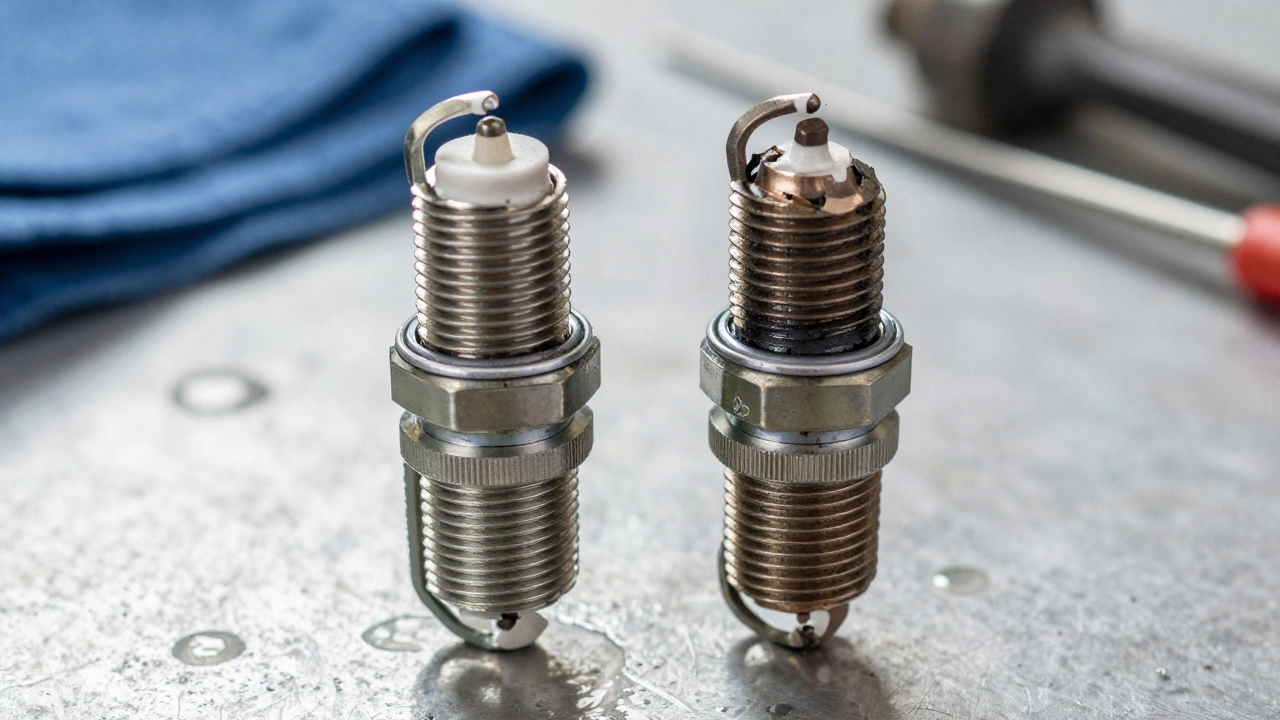
And if you’re curious, pull one out. Look for:
- Black, sooty deposits (rich fuel mixture)
- White or blistered electrodes (overheating)
- Worn-down or rounded electrodes (age)
- Cracked ceramic
If any of these are present, you’re running on borrowed time.

When to replace spark plugs
Don’t wait for failure. Follow your car’s manual-but here’s a general guide:- Copper plugs: Every 20,000-30,000 miles
- Platinum plugs: Every 60,000-80,000 miles
- Iridium plugs: Every 80,000-120,000 miles
But mileage isn’t the only factor. If you do a lot of short trips-like commuting in Bristol-your plugs wear faster. Short runs don’t let the engine reach full operating temperature, so carbon builds up. That’s why cars driven mostly for 5-mile commutes need new plugs sooner than those used for long motorway journeys.
Cost comparison: replacing vs ignoring
A set of four new spark plugs costs between £25 and £80, depending on type. Labour at a garage is usually £50-£80. Total: £75-£160.Now, what happens if you don’t replace them?
- Worse fuel economy = £300+ extra per year on fuel.
- Engine misfires = potential damage to the catalytic converter (cost: £800-£1,500 to replace).
- Failed MOT because of high emissions.
- Stranded on the side of the road because the engine won’t start.
Replacing spark plugs is one of the cheapest insurance policies you can buy for your car.
Myth: "If it ain’t broke, don’t fix it"
People say, "My car runs fine with old plugs." But fine isn’t good. Fine means you’re getting 85% of your engine’s potential. Fine means you’re wasting fuel. Fine means you’re risking damage.Think of it like changing your brake pads. You don’t wait until the brakes scream before replacing them. You replace them before they wear down to the metal. Spark plugs are the same. They’re not a "fix when broken" part. They’re a scheduled maintenance item.

What happens if you mix old and new plugs?
Never do it. Mixing old and new spark plugs in the same engine causes uneven firing. One cylinder fires perfectly, another misfires. That creates imbalance. Your engine runs rough. Vibration increases. You risk damaging the crankshaft bearings or the transmission over time.Always replace all spark plugs at once. Even if only one looks bad, the others are close behind.
DIY or professional?
Replacing spark plugs is one of the easiest DIY jobs on most cars. You’ll need:- New spark plugs (correct type and gap)
- Spark plug socket (usually 5/8" or 13mm)
- Extension bar
- Torque wrench (optional but recommended)
- Compressed air or a brush to clean around the plug well
Steps:
- Disconnect the battery to prevent accidental starts.
- Remove the ignition coil or boot from each plug.
- Use the socket to unscrew the old plug.
- Clean the hole with compressed air-don’t let debris fall in.
- Check the gap on the new plug with a feeler gauge (if not pre-gapped).
- Hand-thread the new plug in to avoid cross-threading.
- Torque to spec (usually 15-20 Nm-check your manual).
- Reattach the coil/boot and reconnect the battery.
If you’re not confident, a garage can do it in under an hour. But if you’ve changed an air filter, you can change spark plugs.
Bottom line
Old spark plugs are a hidden drain on your car’s performance, fuel economy, and long-term health. New spark plugs restore power, save fuel, and prevent expensive damage. There’s no scenario where keeping old plugs is the better choice-unless you’re trying to turn your car into a paperweight.Replace them on schedule. Don’t wait for the warning lights. Your wallet, the environment, and your peace of mind will thank you.
Can old spark plugs cause my car to fail an MOT?
Yes. If worn spark plugs cause excessive misfires, your car will emit higher levels of unburned hydrocarbons and carbon monoxide. This triggers a failure under the UK’s MOT emissions test. Even if the engine runs, the test will flag it.
Do I need to replace all spark plugs at once?
Always. Even if only one plug looks bad, the others are just as old and worn. Mixing old and new plugs creates uneven combustion, leading to engine vibration, poor performance, and potential damage to internal components.
Are expensive spark plugs worth it?
For most drivers, yes. Iridium and platinum plugs last longer and fire more efficiently than copper. While they cost more upfront, they reduce fuel consumption and prevent premature wear on other engine parts. Over 100,000 miles, you’ll save more on fuel than the extra cost of the plugs.
How often should I check my spark plugs?
Check them every 30,000 miles or during major services. If you drive mostly short trips in city traffic, check them every 20,000 miles. Don’t rely on how the car feels-worn plugs often don’t cause obvious symptoms until it’s too late.
Can spark plugs affect my car’s acceleration?
Absolutely. Weak or inconsistent sparks mean incomplete fuel combustion. That directly reduces engine power. You’ll notice sluggish acceleration, especially when overtaking or climbing hills. New plugs restore throttle response and make driving feel more responsive.