Car Battery Selector Tool
Find Your Correct Car Battery
Test Your Current Battery
Check your battery voltage to see if it's still healthy:
Dead battery. Your car won’t start. No lights. No clicks. Just silence. It’s 7 a.m. on a cold December morning, and you’re already late. Before you call a tow truck or jump-start it with a stranger’s cables, ask yourself: is this really just a dead battery-or is it the wrong battery? Many people replace their car battery with the first one that fits in the tray, only to have the same problem again in six months. The truth? Not all car batteries are created equal. Using the wrong one can damage your car’s electrical system, shorten its life, or leave you stranded again. Here’s how to find the correct battery for your car-no guesswork, no online confusion, no wasted cash.
Check Your Owner’s Manual First
The easiest and most reliable way to know what battery your car needs? Look in the owner’s manual. Most manufacturers list the exact battery specification: group size, cold cranking amps (CCA), reserve capacity (RC), and terminal layout. If you’ve lost yours, most car makers offer free digital copies online. Just search for your make, model, and year, plus "owner’s manual PDF". For example, a 2020 Ford Focus in the UK typically needs a 063 or 075 group size battery with at least 540 CCA. That’s not a suggestion-it’s the factory requirement.
Why does this matter? Your car’s starter motor, alternator, and onboard computer are designed to work with a specific power output. A battery with too little CCA won’t turn the engine over in winter. One with too much can overload the charging system. It’s not about power-it’s about balance.
Understand Battery Group Size
The group size is the physical dimensions and terminal placement of the battery. It’s not random. Every car model is built to fit a specific battery shape. If the battery is too wide, it won’t fit in the tray. Too tall? It might hit the hood. Terminals on the wrong side? You can’t connect the cables without bending or cutting them.
Group sizes are standardized by the Battery Council International (BCI). Common sizes in the UK include:
- 063 - Small hatchbacks like the VW Polo or Renault Clio
- 075 - Mid-size family cars like the Ford Focus or Vauxhall Astra
- 121 - Larger sedans and SUVs like the BMW 3 Series or Audi A4
- 096 - Premium or performance models with higher electrical demands
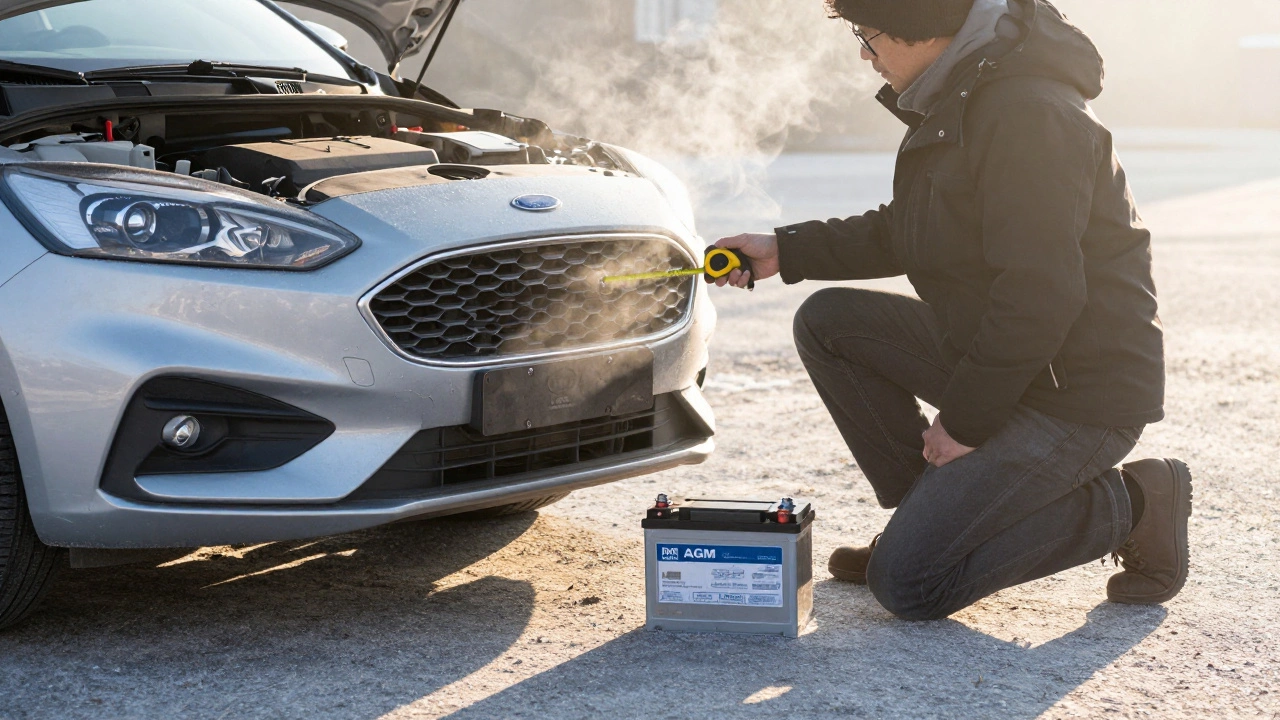
Never assume your old battery’s size is correct. Older batteries can swell, melt, or get cut down during improper installations. Always measure: length, width, height, and terminal position. A tape measure takes 30 seconds. A wrong battery can cost you £150 and a week of rental car fees.
Match Cold Cranking Amps (CCA)
CCA measures how much power a battery can deliver at 0°F (-18°C). That’s critical in the UK, where winter temperatures regularly drop below freezing. A battery with 450 CCA might work fine in summer. In January? It won’t turn your engine over. Most modern petrol cars need at least 500 CCA. Diesel engines? You need 600 CCA or more. Why? Diesel engines have higher compression and require more torque to start.
Here’s a simple rule: never go below the CCA rating listed in your manual. Going higher is usually safe-if your alternator can handle it. Most modern cars can. But don’t go overboard. A 1000 CCA battery in a small city car is overkill and costs twice as much. Stick to the range: ±50 CCA above the minimum is fine.
Reserve Capacity Matters Too
Reserve Capacity (RC) tells you how long the battery can power your car’s electronics if the alternator fails. It’s measured in minutes. A typical battery has 80-120 minutes of RC. That might sound like a lot, but if you’re stuck in traffic with the heater, headlights, and infotainment on, you’ll drain it fast.
Modern cars have dozens of electronic systems: keyless entry, rear cameras, adaptive cruise, heated seats. Even when the engine is off, they’re drawing small amounts of power. A battery with low RC will die faster during short trips or frequent stop-start driving. If your car is a 2022 or newer, aim for at least 90 minutes. For high-tech models like a Toyota RAV4 Hybrid or a Volvo XC40, 110+ minutes is better.
Terminal Position and Type
Terminal location isn’t just about fitting-it’s about safety. Most UK cars use top-post terminals (positive on the right). But some European models use side terminals. If you buy a battery with side terminals and your car has top-post clamps, you’ll need an adapter. Adapters are cheap, but they’re also a potential point of failure. Corrosion, loose connections, arcing-it all starts here.
Also check polarity. Positive on the left? That’s rare in UK cars but common in some older German models. If you hook up the cables backward, you can fry your ECU, alternator, or radio. Always double-check the + and - markings on the battery and your car’s terminals before connecting anything.
Lead-Acid vs. AGM vs. EFB
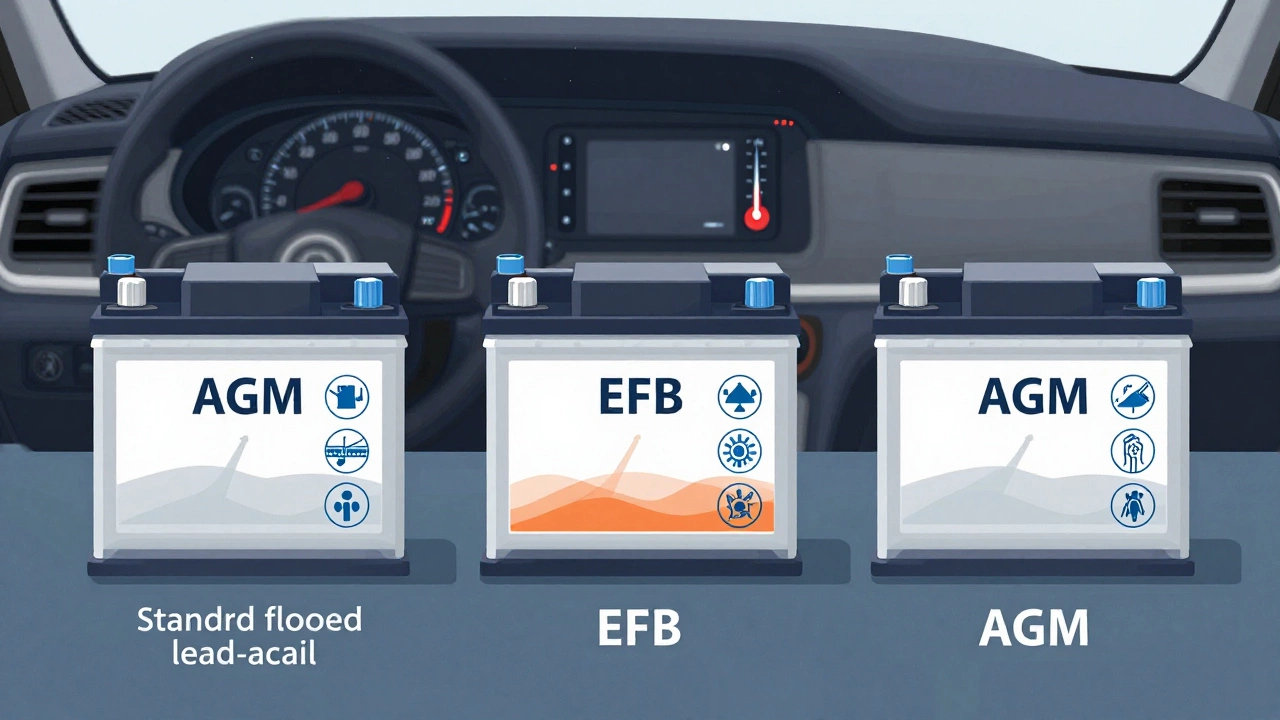
Not all batteries are the same inside. There are three main types:
- Standard Flooded Lead-Acid - The cheapest option. Works fine for basic cars without start-stop systems.
- EFB (Enhanced Flooded Battery) - Designed for entry-level start-stop cars. Handles deeper discharges better than regular lead-acid.
- AGM (Absorbent Glass Mat) - The premium choice. Used in most cars with start-stop, regenerative braking, or high electrical loads. More expensive, but lasts longer and performs better in cold weather.
Here’s the catch: you can’t just swap an AGM for a standard battery if your car needs it. If your car has start-stop (it automatically shuts off at traffic lights), using a regular battery will kill it in under a year. The system expects the higher cycle life and faster recharge of AGM. The same goes for EFB-don’t downgrade.
Check your old battery. If it says "AGM" or "EFB" on the label, replace it with the same type. If you’re unsure, look up your car’s VIN on a parts site like Autodoc or Euro Car Parts. They’ll tell you exactly what was fitted originally.
Brand and Warranty: What Actually Matters
Brands like Bosch, Varta, and Yuasa dominate the UK market. They’re reliable. But don’t pay extra for fancy packaging. A £70 Varta AGM battery performs the same as a £90 "premium" version from a brand you’ve never heard of. What you’re paying for is warranty and service.
Look for at least a 3-year warranty. Some offer 5 or even 7 years. But here’s the trick: the warranty is often pro-rata. That means if it dies after 4 years, you might only get £20 back. A 3-year full replacement warranty is better value than a 7-year pro-rata one. Also, check if the retailer offers free fitting. Most major chains like Halfords, Kwik Fit, or Battery Point do.
What Happens If You Get It Wrong?
Using the wrong battery doesn’t always cause immediate damage. Sometimes it just acts up in winter. But here’s what can go wrong:
- Too small? Slow starts, dim lights, flickering dashboard warnings.
- Too big? Physical damage to the battery tray, melted terminals, or even a fire risk if terminals touch metal.
- Wrong CCA? Stranded in the snow. Or, worse, your alternator overworks trying to compensate.
- Wrong type (AGM vs. standard)? Your start-stop system shuts off permanently. Your car’s computer throws error codes. Repair costs can hit £500+.
One real case from Bristol: a customer replaced his 2018 VW Golf’s AGM battery with a standard one to save £60. Three months later, the start-stop system failed. The car wouldn’t idle properly. The garage said the ECU had to be reprogrammed-and the battery had to be replaced again. Total cost: £420.
How to Test Your Current Battery
Before you buy a new one, test the old one. Most garages offer free battery tests. But you can do a quick check at home:
- Turn off the engine. Turn on the headlights for 2 minutes (this removes surface charge).
- Turn them off. Wait 5 minutes.
- Use a multimeter. Set it to DC voltage. Touch red to positive, black to negative.
- Readings:
- 12.6V or higher = fully charged
- 12.4V = 75% charged
- 12.2V = 50% charged (time to replace)
- Below 12.0V = dead or failing
If it reads below 12.2V after resting, it’s not holding a charge. Replace it. But if it’s above 12.5V and still won’t start? The problem isn’t the battery. Could be the starter, alternator, or a parasitic drain.
Final Checklist Before Buying
Before you hand over your card, run through this:
- ✅ Group size matches your manual or old battery
- ✅ CCA meets or exceeds manufacturer’s minimum
- ✅ Reserve Capacity is 90+ minutes
- ✅ Terminal type and position match your car
- ✅ Type (AGM/EFB/standard) matches original
- ✅ Warranty is at least 3 years full replacement
- ✅ Retailer offers free fitting and disposal
Stick to these rules, and you’ll never be stranded because of a battery again. The right battery isn’t the cheapest. It’s the one designed for your car-not your budget.
Can I use a larger battery if it fits in the tray?
No. Even if it physically fits, a larger battery may have higher CCA or different terminal positions that can damage your car’s electrical system. Always match the group size and specifications listed in your owner’s manual.
How long should a car battery last in the UK?
Most car batteries last 3 to 5 years in the UK. Cold winters, short trips, and frequent stop-start driving reduce lifespan. AGM batteries tend to last longer-up to 6 years-if properly maintained.
Do I need to code my car after replacing the battery?
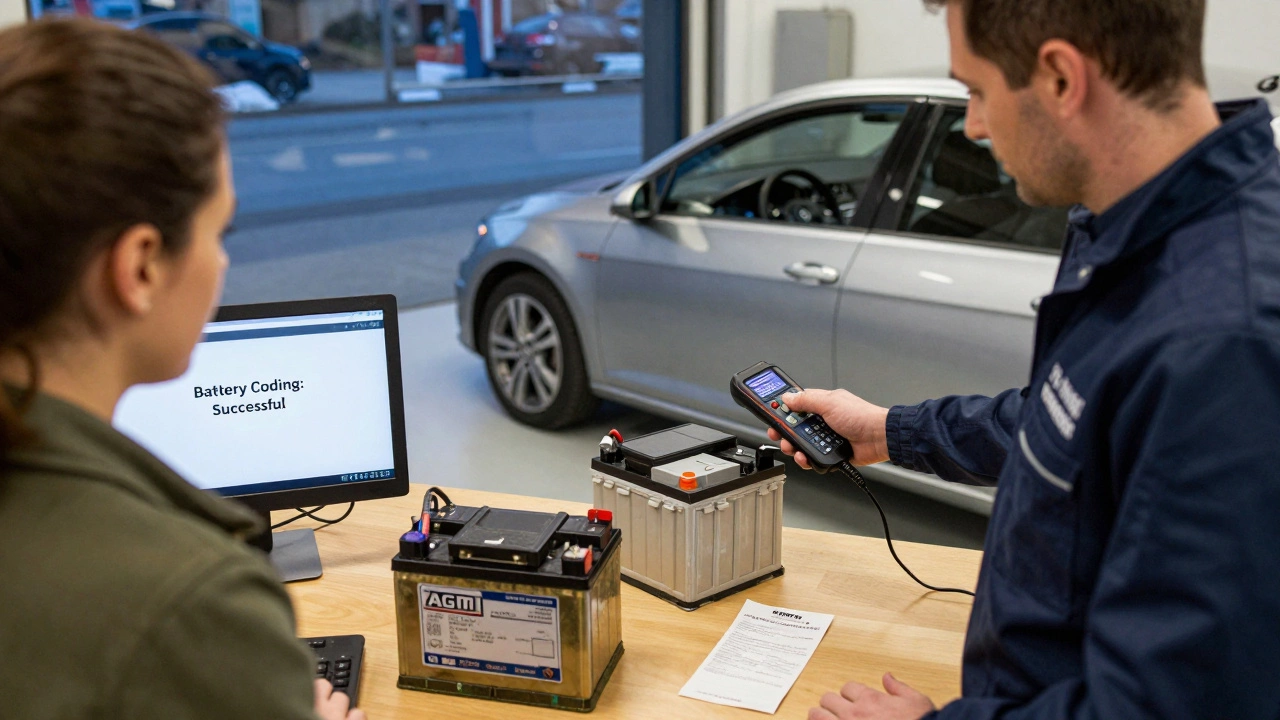
If your car has a start-stop system or advanced electronics (most cars from 2015 onward), yes. The battery management system needs to be reset to recognize the new battery’s capacity. Many garages do this for free when they install it. DIY replacement? You’ll need a diagnostic tool like an OBD2 scanner with battery coding function.
Is a more expensive battery always better?
Not necessarily. Brands like Varta, Bosch, and Yuasa offer reliable performance at fair prices. Paying extra for marketing or flashy packaging won’t improve performance. Focus on CCA, group size, type (AGM/EFB), and warranty instead.
Can I use a motorcycle battery in my car?
No. Motorcycle batteries are designed for low cranking power and light loads. They can’t handle the high current draw of a car starter motor. Using one will damage the battery and could leave you stranded immediately.
If you’re unsure after checking all this, take your car’s registration number to a local battery specialist. They can pull up the exact specs from a database. It takes 2 minutes. It’s free. And it’s better than guessing.