Spark Plug Fuel Economy Calculator
How Spark Plugs Affect Your Fuel Savings
This calculator shows potential savings from replacing worn spark plugs based on real-world data from the article. Remember: New spark plugs only improve fuel economy if your old plugs were actually worn out.
Your Vehicle Information
Result Summary
Enter your vehicle details to see potential savings.
Ever noticed your car’s gas mileage dropping and wondered if new spark plugs could fix it? You’re not alone. Many drivers believe swapping out old spark plugs is a magic bullet for better fuel economy. But is that true? Let’s cut through the noise and look at what actually happens when spark plugs wear out-and whether replacing them will save you money at the pump.
How Spark Plugs Work
Spark plugs are the ignition source in your engine. Each one sits in the cylinder head and fires a tiny electric spark to ignite the air-fuel mixture. That spark happens thousands of times per minute while you’re driving. If the spark is weak, delayed, or missing entirely, the combustion process gets messy. That means unburned fuel escapes through the exhaust instead of turning into power. That’s not just wasted money-it’s also bad for emissions.
Modern spark plugs are designed to last anywhere from 30,000 to 100,000 miles, depending on the type. Copper plugs wear out faster (around 30,000 miles), while iridium or platinum ones can last up to 100,000 miles. But even the best ones degrade over time. Carbon buildup, electrode erosion, and oil contamination all chip away at their performance.
What Happens When Spark Plugs Go Bad
A failing spark plug doesn’t always trigger a check engine light. Sometimes, the symptoms are subtle. You might notice:
- Slower acceleration when you press the gas
- Engine misfires, especially when idling
- Hard starts in cold weather
- A rough idle that vibrates through the steering wheel
These aren’t just annoyances-they’re signs your engine isn’t burning fuel efficiently. When combustion is incomplete, you’re using more fuel to get the same amount of power. Studies from the Automotive Aftermarket Industry Association show that severely degraded spark plugs can reduce fuel economy by up to 30%. That’s not theoretical-it’s based on real-world testing of vehicles with worn plugs.
But here’s the catch: if your spark plugs are still within their service life, replacing them won’t boost your mileage. You can’t make a good system better by swapping in new parts. The gains only come when you fix a broken one.
Do New Spark Plugs Improve Fuel Economy?
Yes-but only if your old ones were already failing.
If your car has 80,000 miles on it and you’ve never changed the plugs, switching to new iridium plugs could bring back 4% to 6% in fuel efficiency. That might not sound like much, but for a car that gets 25 mpg, that’s an extra mile per gallon. Over a year, with 12,000 miles driven, that’s 48 gallons of fuel saved. At £1.60 per litre, that’s over £200 in savings.
But if your plugs were replaced at 60,000 miles and you’re now at 75,000 miles? No measurable gain. The system is still working as designed. You’re not getting a performance upgrade-you’re just replacing a part that still works.
Some aftermarket brands claim their spark plugs “increase fuel economy by 15%.” That’s marketing hype. Independent tests by the UK’s Society of Motor Manufacturers and Traders found no consistent improvement beyond factory specifications. Stick to OEM-recommended plugs. Don’t pay extra for flashy claims.
When Replacement Actually Makes a Difference
Here’s when changing spark plugs helps your fuel economy:
- You’ve passed the manufacturer’s recommended replacement interval
- Your car has misfires or rough idling
- You’ve noticed a drop in mileage over the last 2,000-3,000 miles
- You’ve had recent engine work that exposed the plugs to oil or coolant
For example, if your 2019 Honda Civic started using 10% more fuel after a head gasket repair, the spark plugs likely got contaminated. Replacing them then makes sense. But if you’re just doing “preventive maintenance” on a car that drives fine? You’re spending £80-£150 for no return.
What Else Affects Fuel Economy More Than Spark Plugs
Spark plugs matter-but they’re not the biggest factor. Here’s what actually moves the needle:
- Dirty air filters-A clogged filter can cut fuel economy by up to 10%. Easy fix, cheap part.
- Underinflated tires-Every 1 psi below recommended pressure drops mileage by 0.3%. A full 5 psi low? That’s a 1.5% loss. Check your tires monthly.
- Old engine oil-Thick, dirty oil increases friction. Switching to the right viscosity (like 0W-20 instead of 10W-40) can improve efficiency by 2-3%.
- Driving habits-Rapid acceleration and high speeds burn way more fuel. Smooth driving often saves more than any part swap.
Fixing these things usually costs less and gives better results than replacing spark plugs on a hunch.

How to Know If Your Spark Plugs Need Replacing
You don’t need to guess. Here’s how to find out for sure:
- Check your owner’s manual for the recommended replacement interval.
- Use an OBD2 scanner-look for misfire codes (P0300-P0304).
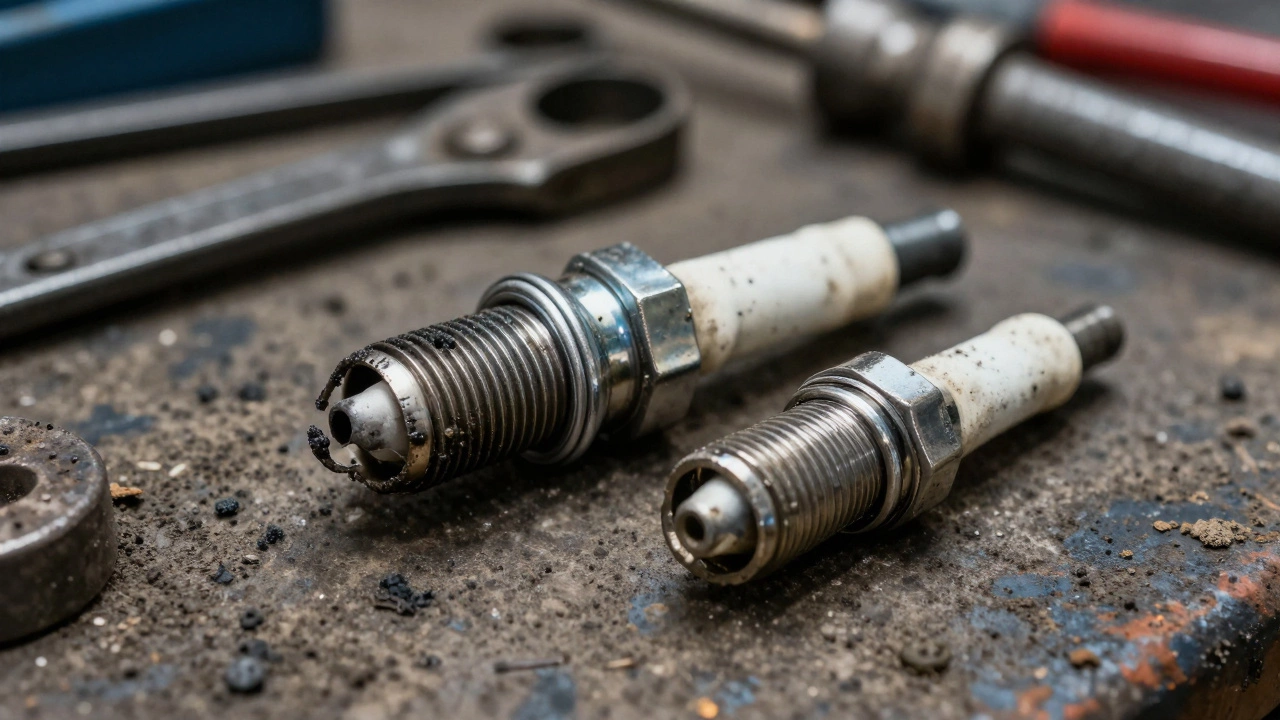
- Remove one plug and inspect it. Look for:
- Black, sooty deposits → rich fuel mixture
- White or blistered electrodes → overheating
- Worn-down center electrode → normal wear after 80,000+ miles
- If the gap is wider than the spec in your manual (usually 0.028-0.044 inches), it’s time.
Most garages will charge £50-£100 to replace all plugs. If you’re handy, you can do it yourself for under £30 in parts. Just make sure you use the right type. Mixing up iridium with copper can damage your engine.
Bottom Line: Spark Plugs Don’t Boost Mileage-They Prevent Loss
Spark plugs don’t magically make your car more efficient. They prevent it from becoming less efficient. If they’re worn, replacing them can bring fuel economy back to where it should be. If they’re still good? You’re just spending money for peace of mind.
Don’t replace them because you think it’ll improve mileage. Replace them because they’re old, dirty, or causing problems. And while you’re at it, check your tires, air filter, and oil. Those changes will do more for your fuel economy than any spark plug ever could.
Can new spark plugs improve my car’s fuel economy?
Only if your old spark plugs were worn out or malfunctioning. If your engine was already running efficiently, new plugs won’t boost mileage. They restore lost efficiency-they don’t add extra.
How often should I replace spark plugs for best fuel economy?
Follow your vehicle’s manufacturer schedule. Copper plugs every 30,000 miles, platinum around 60,000, and iridium up to 100,000. Replacing them before they fail keeps your engine burning fuel cleanly.
Do expensive spark plugs give better fuel economy?
Not necessarily. Iridium and platinum plugs last longer and maintain consistent spark, but they don’t improve efficiency beyond OEM specs. Paying extra for performance claims is usually wasted money.
Can bad spark plugs cause the check engine light to come on?
Yes. Misfire codes like P0301 through P0304 are classic signs of failing spark plugs. If your check engine light is on and you’ve never changed the plugs, that’s a strong indicator they need replacing.
Is it worth replacing spark plugs if my car runs fine?
Only if you’re approaching the recommended replacement mileage. If your car drives smoothly and has good fuel economy, there’s no benefit to replacing them early. Wait until they’re due-or until symptoms appear.