
Wiper Blade Selector Tool
Find Your Wiper Specs
Select the option that best describes your situation.
Look at the metal part where the blade attaches to the arm.
J-Hook
Curved HookSide Pin
Pin on sideTop Pin
Pin on topBayonet
Twist LockYour Recommended Specs
Verified--
inches--
inchesPro Tip: Which Blade Style?
Beam blades are recommended for better performance in snow, ice, and high speeds due to even pressure distribution.
You’re stuck in a downpour. The rain is hammering your windshield, but your view is a smeared mess of streaks and dry patches. You know you need new windscreen wipers, but walking into an auto parts store feels like stepping into a maze. There are dozens of brands, sizes, and connector types on the shelf. How do you know which one fits your specific vehicle? Buying the wrong pair is frustrating-they won’t attach, or worse, they scratch your glass.
Finding the right wipers isn’t rocket science, but it does require knowing where to look and what terms mean. You don’t need to be a mechanic to get this right. With a few minutes of checking your current setup or looking up your vehicle’s details, you can ensure a perfect fit every time.
Check Your Current Wiper Blade Length
The most critical specification for any wiper blade is its length. Wiper blades come in standard increments, usually measured in inches. Common sizes range from 10 inches for smaller rear windows to 26 inches for large SUV windshields. If you buy a blade that is too long, the ends will overlap when the wipers move, causing them to bang against each other and potentially damage the mechanism. If they are too short, you’ll have blind spots at the edges of your windshield.
Here is how to measure them accurately:
- Remove the old blade: Lift the wiper arm away from the glass. Press the small release tab on the connector and slide the blade off the hook.
- Lay it flat: Place the rubber blade on a flat surface, like the hood of your car or a table.
- Measure the rubber: Use a tape measure to find the length of the actual rubber wiping element, not the metal frame. Measure from one end of the rubber to the other.
- Note both sides: Driver-side and passenger-side wipers are often different lengths. Write down both numbers immediately.
If your old blades are completely worn out or missing, don’t guess. Measuring the empty wiper arms is tricky because the attachment point varies. In that case, skip to the section on using your vehicle identification number.
Identify the Connector Type
Even if you have the correct length, the wiper blade won’t work if it doesn’t fit onto your wiper arm. This connection point is called the adapter or connector. Manufacturers use several standard designs, and while some universal adapters exist, knowing your native type saves hassle.
| Connector Name | Description | Typical Vehicles |
|---|---|---|
| J-Hook | A simple curved hook shape. The most common type worldwide. | Most American, European, and Asian cars made after 1990. |
| Side Pin | A pin protrudes from the side of the wiper arm. | Many Honda, Toyota, and Ford models. |
| Top Pin | A pin comes out of the top of the wiper arm. | Some older European vehicles and trucks. |
| Bayonet | A twist-and-lock mechanism with multiple prongs. | Volkswagen, Audi, BMW, and Mercedes-Benz. |
| U-Hook | Similar to J-Hook but with a wider base. | Some commercial vans and older sedans. |
If you remove your current blade, look at the metal piece that attaches to the arm. Does it look like a hook? A pin? A bayonet lock? Take a photo of it with your phone. When shopping online, you can compare your photo to the product images. Many modern "universal" wiper kits come with a bag of adapters that convert a J-Hook style to almost any other type. If you buy these, you just need to match the adapter to your arm, then snap the main blade onto the adapter.
Use Your Vehicle Identification Number (VIN)
If you can’t remove the old blades or they are gone entirely, your VIN is the gold standard for accuracy. The VIN is a 17-character code unique to your vehicle, found on your registration, insurance card, or etched into the dashboard near the windshield on the driver’s side.
Most major auto parts retailers-both online and in-store-have a lookup tool. You simply enter your year, make, model, and sometimes trim level. For example, a 2024 Toyota Camry LE might have different wiper sizes than a 2024 Toyota Camry XSE if the window shapes differ slightly. Using the VIN ensures the system pulls the exact factory specifications for your specific build.
This method also accounts for special cases. Some luxury cars have heated wiper parks or integrated sensors that require specific low-profile blades. A generic search by model name might miss these nuances, but a VIN lookup rarely does.
Choose Between Framed and Beam Blades
Once you know the size and connector, you face a choice in design: traditional framed blades or modern beam blades. This decision affects performance, especially in extreme weather.
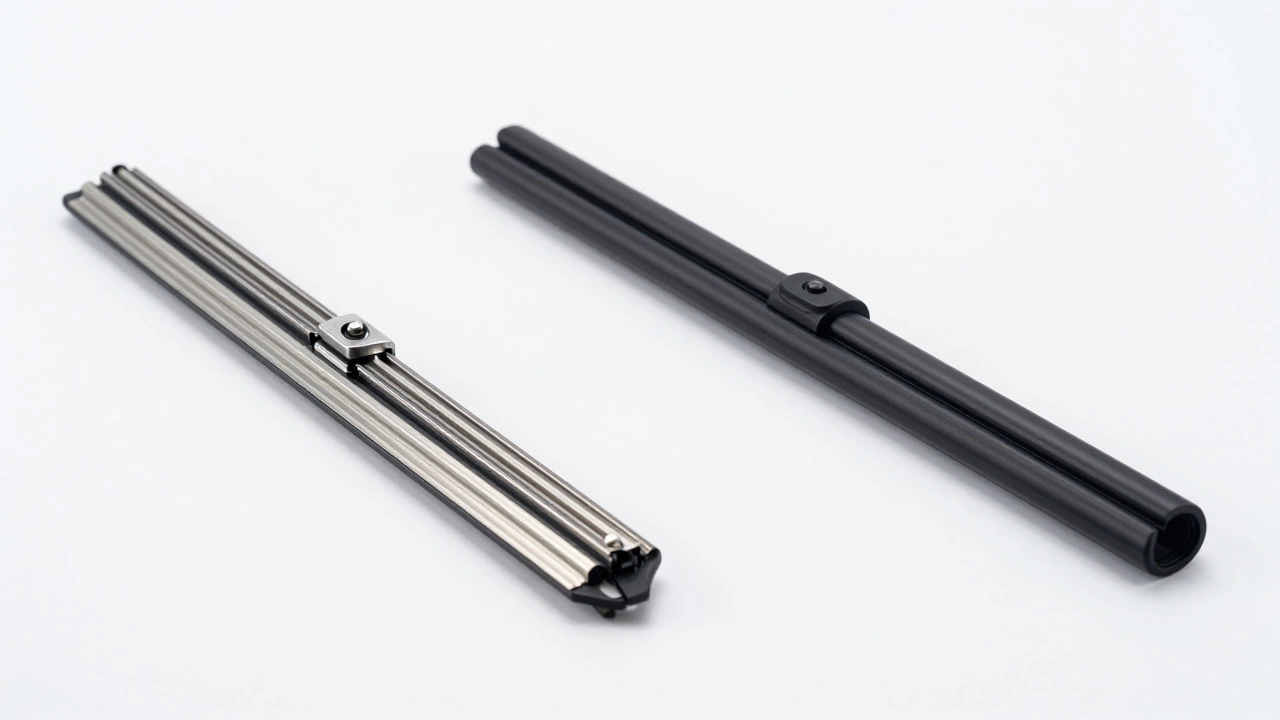
Framed Wiper Blades are traditional blades with a metal skeleton that holds the rubber strip against the glass. They are inexpensive and widely available. However, the metal joints can collect ice and snow, leading to uneven pressure. In very cold climates, the frame can become stiff, causing skipping and streaking.
Beam Wiper Blades are frameless designs made from a single piece of flexible steel or composite material wrapped in rubber. They sit flatter against the windshield, providing even pressure across the entire blade. They are more aerodynamic, which reduces lift at high speeds, and they shed snow and ice much better. While they cost slightly more upfront, they generally last longer and provide clearer visibility in winter conditions.
If you live in an area with heavy snow or frequent hail, invest in beam blades. If you are on a tight budget and live in a mild climate, framed blades will do the job fine.
Don't Forget the Rear Wiper
It’s easy to overlook the back window until you’re reversing into a rainy garage. Most hatchbacks, SUVs, and minivans have a rear wiper. These blades are typically shorter (often between 10 and 14 inches) and may use a different connector than the front ones. Sometimes the rear wiper uses a direct plug-in connector rather than a mechanical arm.
Check your owner’s manual or the rear wiper arm itself. If it has a removable blade, measure it just like the front ones. If it’s a fixed unit, you may need to replace the entire wiper assembly, which requires matching the part number exactly.

Installation Tips for a Perfect Fit
Getting the right wipers is half the battle; installing them correctly is the other half. A poorly installed wiper can scratch your windshield or fall off while driving.
- Clean the glass first: Before removing the old blades, wash your windshield thoroughly. Remove bugs, tree sap, and road film. Old grime can cause the new rubber to skip.
- Protect the windshield: Lay a towel over the area where the wiper arm rests. If the arm snaps back onto the glass accidentally, the towel prevents cracks.
- Follow the click: When attaching the new blade to the arm, listen and feel for a solid click. If it slides on loosely, it’s not secure. Give it a gentle tug to test.
- Prime the rubber: New wiper rubber can be stiff. Wipe the rubber edge with a little soapy water or a dedicated wiper cleaner before installation. This helps it lay flat immediately.
- Test slowly: Turn on your washer fluid and run the wipers on low speed for a few cycles. Watch for any chattering or lifting. If the blade lifts at high speeds, you may need an aerodynamic beam blade instead.
When to Replace Wipers
Wiper blades are consumable items. Sunlight, ozone, and temperature changes degrade the rubber over time. Most manufacturers recommend replacing them every 6 to 12 months. Signs you need new ones include:
- Streaking or smearing on the glass.
- Squeaking or chirping noises during operation.
- Visible cracks, tears, or splits in the rubber.
- Misshapen rubber edges that no longer press evenly against the glass.
Waiting until they fail completely is risky. During a sudden storm, compromised wipers can leave you with zero visibility. Keep a spare pair in your trunk if you travel frequently or live in harsh weather zones.
Can I use any wiper blade on my car?
No. You must match the blade length and the connector type. Using the wrong length can cause overlapping or poor coverage. Using the wrong connector means the blade won’t attach securely and could fly off while driving.
What is the difference between J-Hook and Bayonet connectors?
A J-Hook is a simple curved hook found on most American and Asian cars. A Bayonet connector uses a twist-and-lock mechanism with prongs, common on German brands like VW and BMW. They are not interchangeable without an adapter.
Are beam wipers better than framed wipers?
Generally, yes. Beam wipers provide even pressure, resist ice buildup, and are more aerodynamic. Framed wipers are cheaper but can suffer from uneven wear and freezing in cold climates.
How do I measure wiper blades if they are broken?
If the blades are missing, use your vehicle’s VIN or check the owner’s manual. You can also look up the specifications online by entering your car’s year, make, and model into an auto parts retailer’s website.
Do I need to replace both wipers at the same time?
Yes. It is best practice to replace both front wipers simultaneously. Even if one looks okay, the rubber degrades at similar rates. Mixing old and new blades can lead to uneven cleaning and increased stress on the wiper motor.