Car Battery Health Checker
Check Your Symptoms
Select all symptoms you're experiencing
Battery Age Check
Your Battery Assessment
Based on your inputs, your battery is in good condition.
If your car won’t start on a cold morning, or the headlights dim when you turn on the stereo, you’re not imagining things. Your battery might be giving up. Car batteries don’t just die without warning-they send signals, often subtle, before they give out for good. Knowing these signs can save you from being stranded on a quiet road or stuck in a supermarket car park with the engine clicking but not turning over.
Slow engine crank when you turn the key
The most obvious sign is a slow, labored crank when you try to start the car. Instead of the quick, strong roar you’re used to, the engine turns over sluggishly, like it’s dragging through mud. This isn’t just a bad starter motor. It’s usually the battery struggling to deliver enough amps to get the engine spinning. Cold weather makes this worse because chemical reactions inside the battery slow down. If you live in Bristol and notice this every winter, especially after a few days of rain and damp, your battery is likely near the end of its life.
Dim headlights or electrical issues
Your car’s battery doesn’t just power the starter-it runs the lights, radio, dashboard, and charging system. If your headlights look noticeably dimmer than usual, especially when the engine is off or idling, that’s a red flag. Same goes for flickering interior lights, slow power windows, or the radio cutting out briefly. These aren’t random glitches. They’re symptoms of low voltage. A healthy battery holds 12.6 volts or more when the engine is off. Anything below 12.4 volts means it’s weak. Below 12.0 volts? It’s on its last legs.
Battery warning light on the dashboard
Modern cars have a battery-shaped icon (often with + and - symbols) that lights up when the charging system isn’t working right. If it comes on while driving, it could mean your alternator is failing. But if it stays on even after the engine starts, or flashes on and off, it’s often a sign the battery itself can’t hold a charge anymore. Don’t ignore it. Some drivers think it’s just a sensor glitch, but in 7 out of 10 cases I’ve seen in workshops around Bristol, that light meant the battery was worn out.
Swollen or bloated battery case
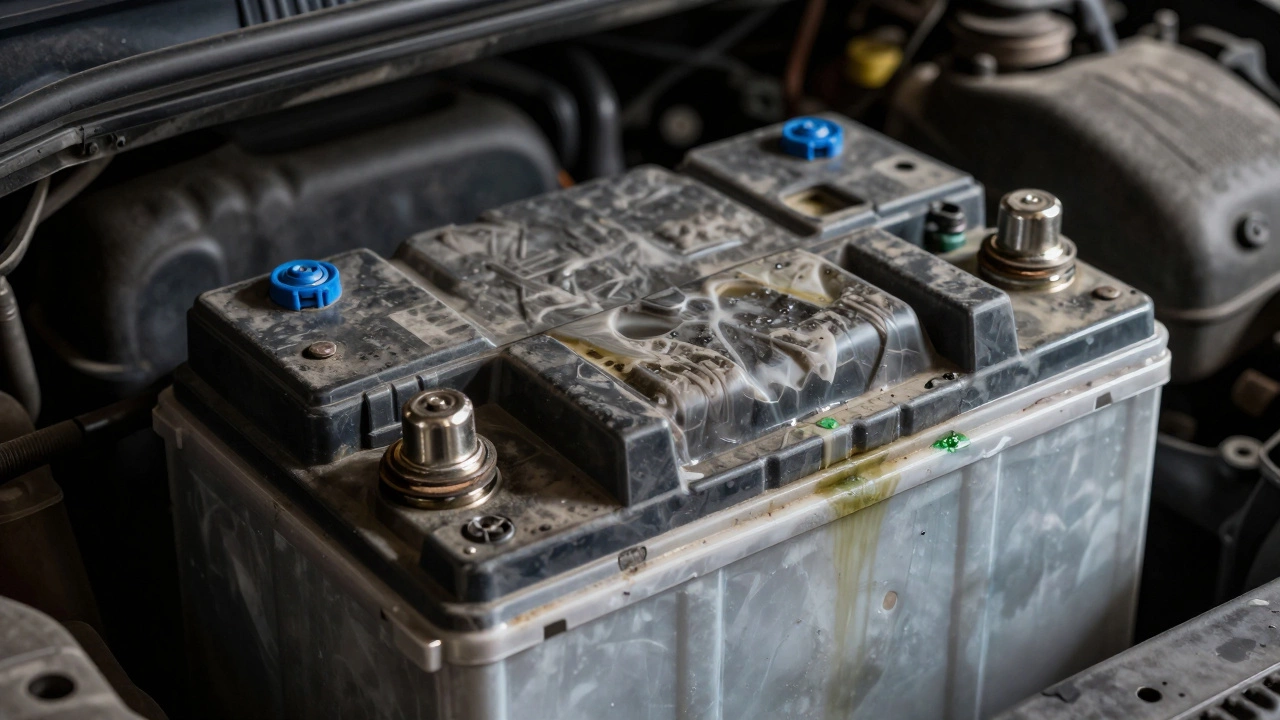
Pop open your hood and take a look at the battery. If the plastic casing looks bulged, warped, or swollen-like it’s been left in the sun too long-it’s damaged. This happens when the battery overheats or gets overcharged, causing internal gases to build up. A swollen battery is dangerous. It can leak acid, crack, or even explode under pressure. Even if the car still starts, replace it immediately. No exceptions. This isn’t a "maybe" situation.
Old age-batteries don’t last forever
Most car batteries last between three and five years. If yours is older than four, you’re in the danger zone. Even if it’s been working fine, the lead plates inside slowly degrade. Heat speeds up this process, and so does frequent short trips. If you only drive to the shops and back, the alternator never gets a chance to fully recharge the battery. Over time, that tiny bit of charge loss adds up. I’ve replaced more batteries in 2025 from people who thought their cars were "fine"-until one morning they just wouldn’t start.
Corrosion around the terminals
That white, green, or blue powdery gunk around the battery terminals? That’s corrosion. It’s caused by acid leaking or hydrogen gas escaping and reacting with the metal. A little bit is normal. A thick crust that’s eating into the terminals? That’s a problem. Corrosion blocks the flow of electricity. Even if the battery has charge, the connection is weak. Clean it with baking soda and water, but if the terminals are pitted or crumbling, the battery’s internal connections are likely failing too. Replacing the battery is cheaper than dealing with repeated starting issues.
Smell of rotten eggs or acid leaks
That rotten egg smell? That’s hydrogen sulfide gas-released when a battery is overcharged or damaged. If you notice this smell when you open the hood, or see wet spots or residue around the battery base, it’s leaking. Acid leaks can eat through your car’s wiring, metal parts, and even your skin. Don’t touch it with bare hands. This isn’t a "I’ll fix it later" problem. A leaking battery needs to come out now. It’s a safety hazard and a sign the battery’s internal structure has broken down.
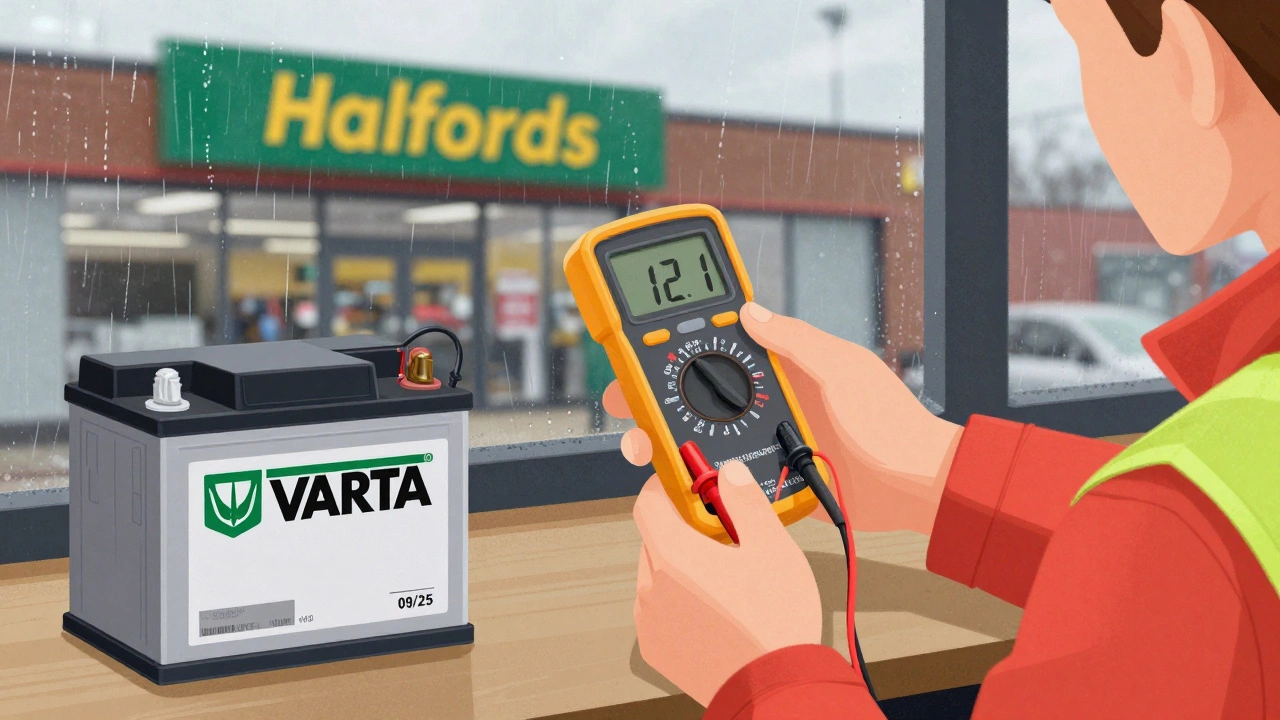
Testing your battery properly
You don’t need a mechanic to check your battery. Most auto parts stores in the UK-Halfords, Kwik Fit, Euro Car Parts-offer free battery tests. They use a load tester that simulates the stress of starting the engine. It tells you if the battery holds charge under load. A battery that reads 12.6 volts at rest but drops below 9.6 volts under load is dead. Even if it reads "good" on a simple voltmeter, the load test is the real judge. If you’re handy, you can buy a basic digital multimeter for under £15 and check it yourself. Just turn off the engine, set the meter to DC volts, and touch the probes to the terminals. Anything under 12.4 volts? Start shopping for a new one.
When to replace it-not just when it dies
Waiting until your car won’t start at all is a gamble. In the UK, winter mornings can be brutal. A battery that’s six months past its warranty might still start the car-but only if you’re lucky. If you’ve had the same battery since 2021, and you’ve noticed any of the signs above, replace it now. A new battery costs between £80 and £150 depending on size and brand. That’s less than a tank of petrol. And it means you won’t be calling a breakdown service at 7 a.m. in the rain.
What to look for in a new battery
Not all batteries are the same. Your car’s manual will list the correct size (group size), terminal placement, and cold cranking amps (CCA). For UK winters, aim for at least 500 CCA. Brands like Varta, Bosch, and Exide are reliable. Avoid bargain-bin batteries-they often have thinner lead plates and shorter lifespans. Also, check the manufacture date. Batteries sit on shelves for months. Look for a date code (like 09/25 for September 2025). Don’t buy one older than six months. A fresh battery gives you the full expected life.
How to extend battery life
Once you’ve got a new battery, keep it healthy. Drive at least 20 minutes once a week to let the alternator fully recharge it. Turn off lights, radio, and chargers when the engine is off. If you don’t drive often, use a trickle charger during long breaks. Keep the terminals clean and tight. And if you park outside, consider a battery insulator blanket in winter-it helps keep the temperature stable.
Can a car battery die suddenly without warning?
Yes, but it’s rare. Most batteries show signs for weeks or months before failing completely. Sudden death usually happens when the battery is already weak and gets hit with extreme cold, or if there’s a manufacturing defect. That’s why checking your battery before winter is smart.
How often should I replace my car battery?
Every three to five years, depending on usage and climate. If you make short trips often, live in a cold area, or notice warning signs, replace it at four years-even if it still works.
Can I jump-start a car with a bad battery?
Yes, you can jump-start it, but it’s only a temporary fix. If the battery can’t hold a charge after being jumped, it’s worn out. Jumping won’t repair it-it just gives you enough power to get to a garage.
Does leaving the lights on kill a car battery?
Yes, even for a few hours. A single set of headlights can drain a healthy battery in 6-8 hours. If this happens once, the battery might recover after a long drive. If it happens often, the battery’s capacity will drop over time.
Should I replace both batteries if my car has two?
Some cars, especially diesel or luxury models, have two batteries. If one fails, replace both at the same time. They age together, and putting a new battery with an old one puts strain on the new one, reducing its lifespan.