Air Filter Visual Test Simulator
Simulate testing your air filter by adjusting the dirt level. The tool shows how light transmission changes with a dirty filter, helping you determine when replacement is needed.

Light Transmission
100%
Filter Status
Good
Key Indicators
Most drivers don’t think about their air filter until their car starts running poorly. But a clogged or dirty air filter can cut fuel efficiency, reduce engine power, and even cause long-term damage. The good news? Testing your air filter takes less than five minutes and costs nothing. You don’t need tools, a mechanic, or a garage. Just your eyes and a little light.
Why Testing Your Air Filter Matters
Your engine needs clean air to burn fuel properly. The air filter traps dust, pollen, road grit, and debris before they reach the engine. If it gets too full, airflow drops. That forces the engine to work harder, which means more fuel use and less power. In extreme cases, dirt can slip through and scratch cylinder walls - a repair that costs hundreds, sometimes thousands.
Most manufacturers recommend replacing your air filter every 12,000 to 15,000 miles. But if you drive on dirt roads, in dusty cities, or during pollen season, you might need to check it every 3,000 to 5,000 miles. Testing it regularly is the only way to know for sure.
What You’ll Need
Nothing. Seriously. No tools. No special equipment. Just:
- A well-lit area (a garage door or doorway works best)
- Your vehicle’s owner’s manual (to find the air filter location)
- A flashlight (optional, but helpful)
You don’t need to buy a filter tester. Those gadgets are marketing hype. The old-school visual check still works better than any gadget.
Step-by-Step: How to Test Your Air Filter
- Locate the air filter housing. Open your hood. Look for a large black plastic box near the front of the engine. It’s usually connected to a thick rubber hose. The housing has clips, screws, or wingnuts holding it shut. Your owner’s manual will show you exactly where it is.
- Remove the filter. Unclip or unscrew the housing. Lift the filter out carefully. Don’t shake it - that could dump dirt into the intake.
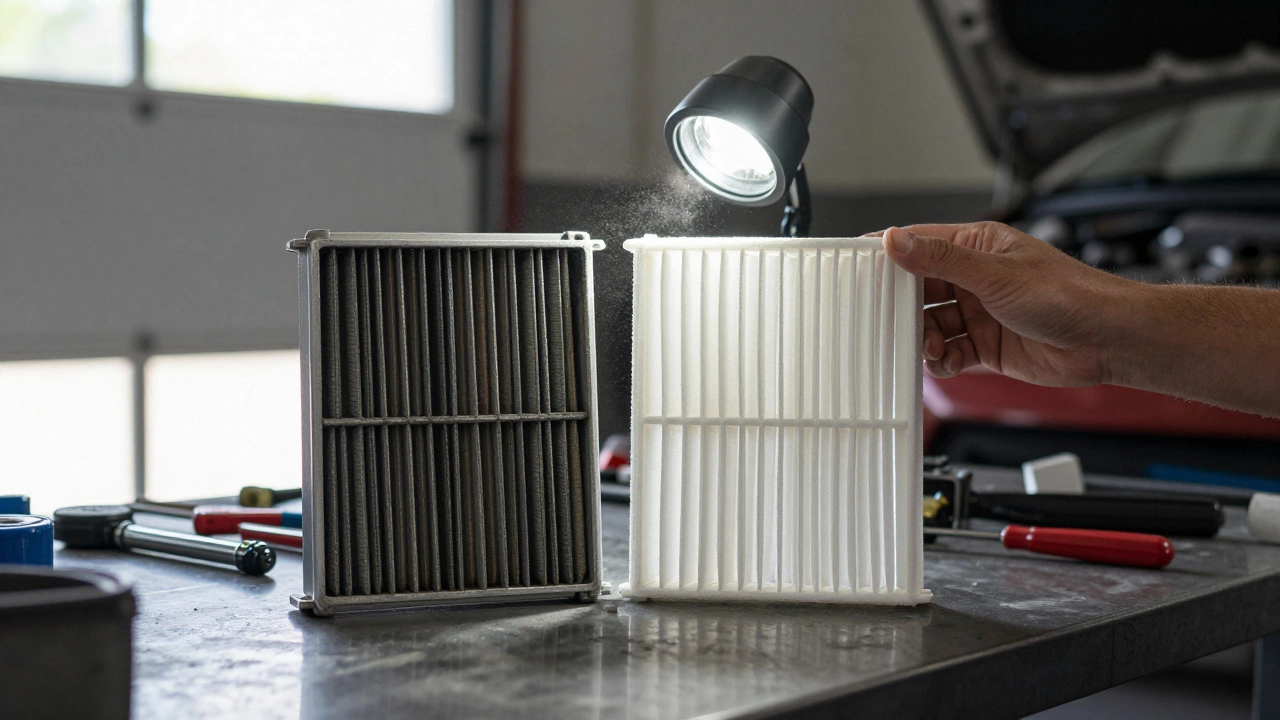
- Hold it up to a bright light. Place the filter between you and a window, garage light, or flashlight. Look through the material. If you can see light clearly passing through the entire surface, it’s still clean. If it looks dark, gray, or you can’t see any light coming through, it’s clogged.
- Check for debris buildup. Look at both sides. If you see thick layers of dirt, leaves, or bugs stuck in the folds, it’s time to replace it. Even if some light gets through, heavy surface dirt means it’s losing efficiency.
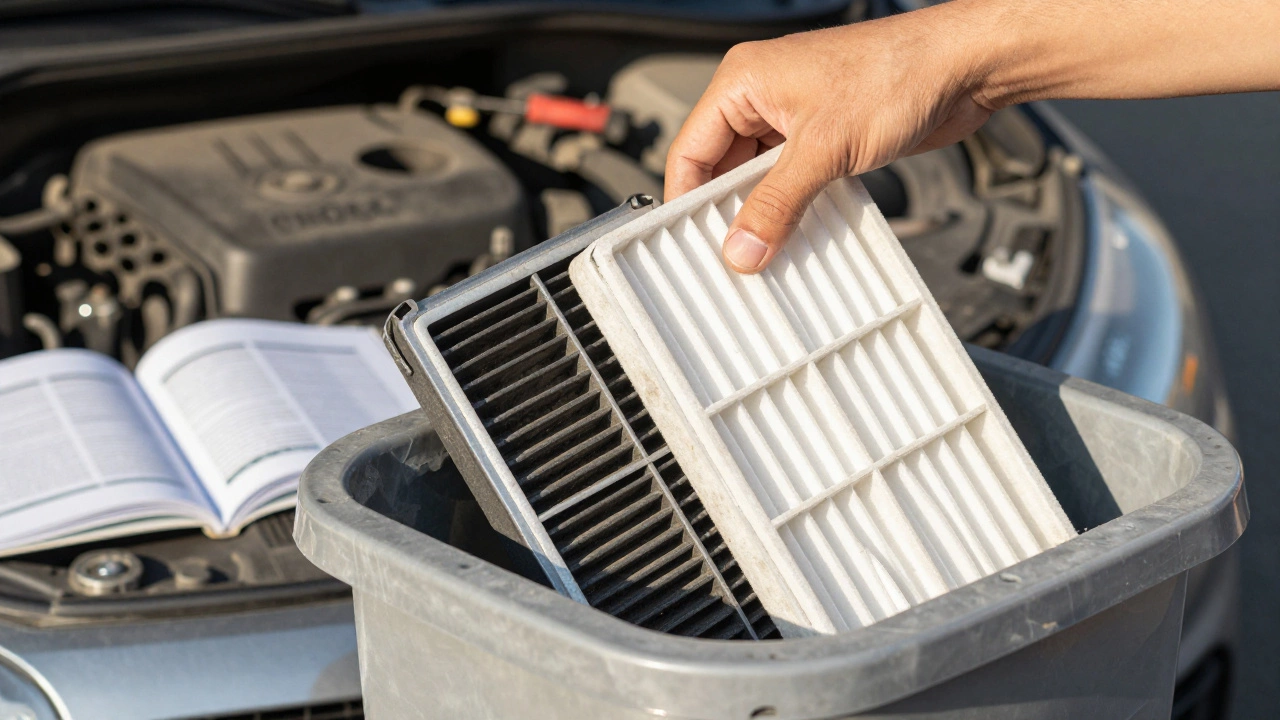
- Compare it to a new one. If you have a spare or just bought a new filter, lay them side by side. The new one should look white or off-white and feel thin and flexible. The old one will look dirty, stiff, and heavier.
What a Clean vs. Dirty Filter Looks Like
Here’s what to look for:
| Feature | Clean Air Filter | Dirty Air Filter |
|---|---|---|
| Color | White or light beige | Dark gray, brown, or black |
| Light Transmission | Light passes through easily | Very little or no light passes through |
| Texture | Soft, flexible, slightly springy | Stiff, brittle, crumbly |
| Debris | No visible dirt or particles | Thick layers of dust, leaves, bugs |
| Weight | Light | Noticeably heavier |
If your filter matches even two of the dirty filter traits, replace it. Don’t wait for the check engine light.
Common Mistakes When Testing
People mess this up more than you’d think. Here are the top errors:
- Shaking the filter to clean it. That just moves dirt around. It doesn’t remove it. You’re risking letting debris into the engine.
- Using compressed air. It can tear the filter material. Even if it looks clean afterward, it’s compromised.
- Assuming it’s fine because it’s not black. A filter can be 70% clogged and still look halfway decent. Light transmission is the real test.
- Waiting for the owner’s manual schedule. If you drive in dusty conditions, the manual’s timeline is a suggestion, not a rule.
When to Replace, Not Just Test
You should replace your air filter if:
- It’s over 12,000 miles old and you haven’t checked it
- You drive on gravel roads, construction zones, or dusty rural areas
- You notice reduced acceleration or lower fuel economy
- The filter looks stiff or crumbly when you touch it
- You’ve had the same filter for more than two years
Replacement filters cost between $15 and $40, depending on your car model. It’s one of the cheapest fixes that gives the biggest return in performance and fuel savings.
What Happens If You Ignore a Dirty Filter
Skipping filter checks doesn’t cause instant failure. But over time, the damage adds up:
- Reduced fuel economy: A clogged filter can drop your MPG by 10% or more. That’s $100+ extra per year.
- Slower acceleration: Your engine struggles to pull in air, so it hesitates when you press the gas.
- Increased emissions: Poor combustion means more unburned fuel exits the tailpipe.
- Engine wear: Tiny particles that slip through can score cylinder walls and damage pistons. That’s not a $30 fix - that’s a $2,000 engine rebuild.
One mechanic told me he saw a 2018 Honda Civic with 120,000 miles that had never had its air filter changed. The intake manifold was coated in thick, oily dust. The owner thought the car was just "getting old." It wasn’t. It was starving for air.
How Often Should You Test It?
Here’s a simple schedule based on driving habits:
- City driving, clean roads: Check every 6,000 miles or every 6 months
- Highway driving, no dust: Check every 10,000 miles
- Dusty, rural, or construction zones: Check every 3,000 miles
- Seasonal tip: Check it in spring after pollen season and in fall after dry leaves pile up
Make it part of your monthly walk-around. While you’re checking tire pressure or windshield fluid, pull out the air filter. Two minutes. That’s all it takes to avoid a costly repair.
Can You Clean and Reuse an Air Filter?
Most standard paper filters are disposable. Cleaning them doesn’t restore their filtering ability - it just makes them look cleaner. Reusing a cleaned paper filter is risky. The material breaks down, and gaps form where dirt slips through.
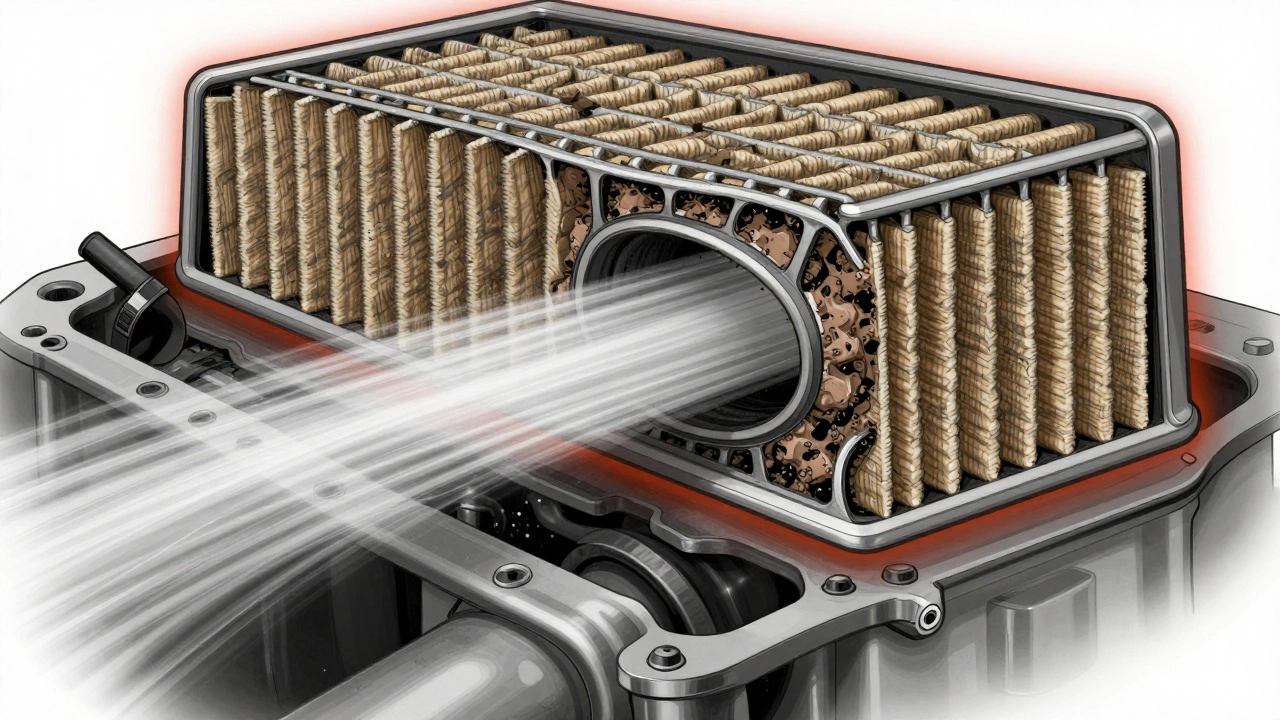
Some high-performance cars use reusable cotton gauze filters. These are designed to be washed, oiled, and reused. But if you don’t have one of those, don’t try to clean your standard filter. Just replace it.
What to Look for When Buying a New Filter
Not all air filters are made equal. Here’s what matters:
- Match your car’s make, model, and year. Use your VIN or check the part number on the old filter.
- Stick with OEM or trusted brands. Fram, K&N, Mann-Filter, and Bosch are reliable. Avoid no-name brands on Amazon with no reviews.
- Check the fit. The filter should snap in snugly. If it’s loose or too tight, it’s the wrong one.
- Don’t buy "high-flow" filters unless you’ve modified your engine. For stock cars, they don’t improve performance - they just let more dirt in.
Install it right. Make sure the housing is clean before putting the new filter in. Wipe out any dust inside. Reattach the clips or screws firmly. A loose housing lets unfiltered air in - defeating the whole purpose.
Can I drive without an air filter?
No. Driving without an air filter is like letting sand blow into your engine. Even a few minutes can cause serious damage. Dust particles are harder than engine components. You might get away with it for a short drive, but it’s not worth the risk.
Why does my car sound louder after replacing the air filter?
That’s normal. A clean filter allows more airflow, which can make the engine intake noise more noticeable. It doesn’t mean something’s wrong. In fact, it’s a sign your engine is breathing better.
Does a dirty air filter trigger the check engine light?
Sometimes. A severely clogged filter can cause the engine to run lean (not enough air), which may trigger codes like P0171 or P0174. But often, the symptoms - sluggish acceleration, poor fuel economy - show up long before the light comes on.
How do I know if my air filter is the right size?
The old filter has the part number printed on the frame. Write it down or take a photo. When buying a new one, match that number exactly. Even a 1/8-inch difference can create gaps that let dust through.
Is it worth spending more on a premium air filter?
For most drivers, no. A $25 OEM replacement filter works just as well as a $60 performance filter. Premium filters are designed for modified engines or racing. For a daily driver, stick with a reliable standard filter. Save your money for oil changes or tires.
Final Tip: Make It a Habit
Testing your air filter isn’t a chore - it’s insurance. Five minutes every few months can save you hundreds in fuel and prevent expensive repairs. Keep a spare filter in your trunk. Next time you’re filling up, take two minutes to peek at it. If it looks bad, swap it out at the next stop. You’ll feel the difference before you even leave the parking lot.